Purpose
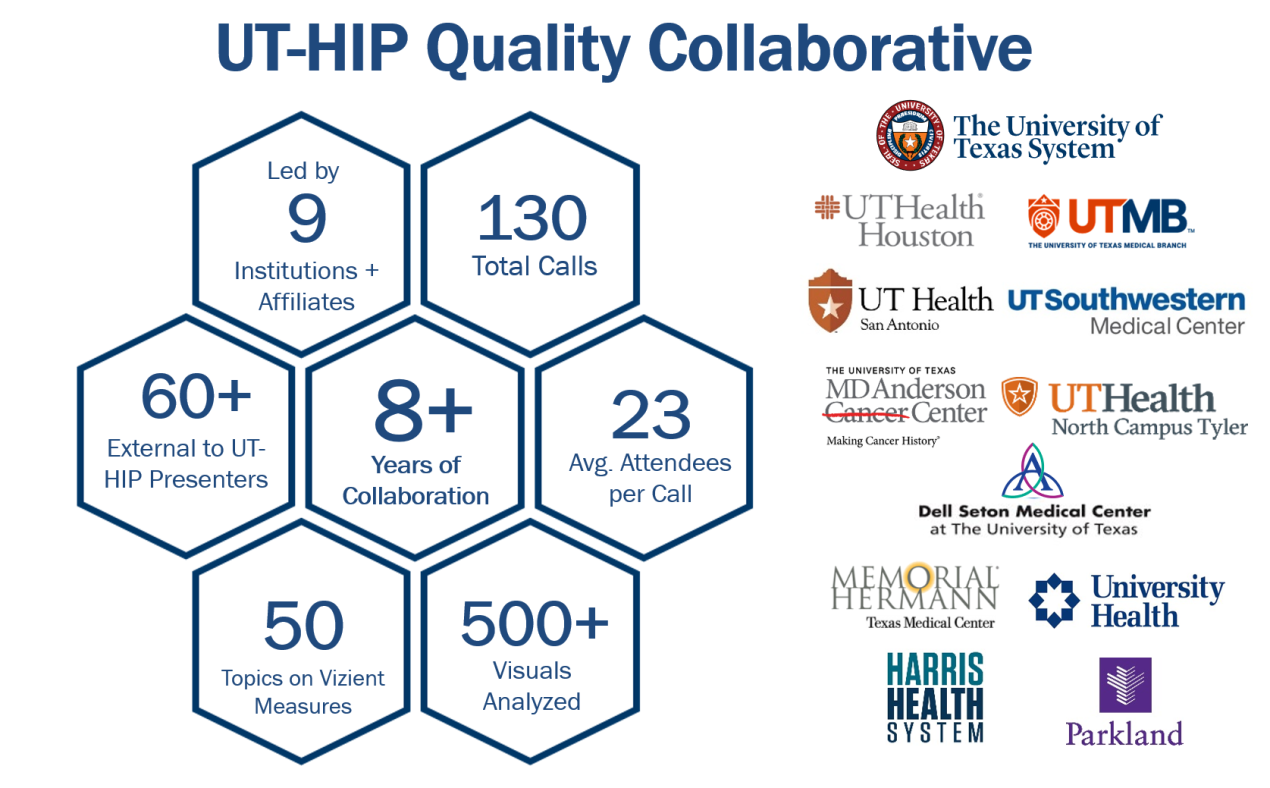
The UT-HIP Quality Collaborative is the systemwide group of Chief Quality Officers and other quality leaders from the nine health and medical institutions within the UT System.
Why Vizient?
Vizient’s Clinical Database (CDB) provides UT System institutions with a trusted, nationally validated framework for measuring and improving quality. As the leading benchmarking platform for academic medical centers—representing 97% of AMCs, over 69% of acute care hospitals, and more than 35% of the ambulatory market. The Vizient Quality and Accountability (Vizient Q&A) data is also used to better visualize performance on the individual metrics that contribute to the overall Vizient score, a nationally recognized hospital ranking system.
Vizient delivers monthly, risk-adjusted insights on mortality, length of stay (LOS), readmissions, hospital-acquired conditions, cost, and efficiency. By comparing performance within tailored peer cohorts and tracking progress over time, UT System hospitals gain a fair, accurate view of where they excel and where opportunities for improvement exist.
Vizient’s annual national rankings and awards further recognize excellence and support our systemwide commitment to delivering high-quality, high-value care.
Strategic Goals
Advance Excellence in Quality and Value Across the UT System
Drive continuous improvement in the quality, safety, and value of care delivered to patients by aligning shared priorities, strengthening performance, and elevating systemwide standards.
Promote Shared Learning and Best Practices
Facilitate open, ongoing exchange of insights, innovations, and lessons learned to accelerate improvement and reduce unwarranted variation across institutions.
Foster Systemwide Collaboration to Improve Patient Outcomes
Build a unified community of clinicians, analysts, and leaders who work together across UT System institutions to identify opportunities, solve challenges, and advance high-impact quality initiatives. The primary audience for the Quality Collaborative calls are Quality and Safety personnel across our participating institutions, including Chief Quality Officers, Chief Medical Officers, Quality Directors and Analysts. Additionally, we also invite Physician/ Surgical, Nursing, Pharmacy, Patient Satisfaction, Infection prevention leaders and personnel to attend relevant calls.
Series Overview
2017: Establishing a Multi-Institutional Improvement Initiative
A system-wide scorecard was created using Vizient data to highlight high-impact opportunities for improving patient outcomes.
- Identified pulmonary embolism and deep vein thrombosis as key contributors to post-surgical morbidity and mortality
- Facilitated cross‑institution discussions on effective initiatives and best practices for mortality reduction
2018: Increased Emphasis on Data-Driven Initiatives and Value-Based Care
The Quality Collaborative deepened its focus on analytics and system-wide value through benchmarking to identify variation and highlight successful initiatives across the UT system.
- Built Vizient Q&A dashboards to improve visibility into performance drivers
- Used the systemwide scorecard to identify readmissions in heart Failure patients and colon surgical site infections as priority improvement areas
- Expanded mortality discussion by focusing on end-of-life care for lung cancer patients
- Facilitated discussions on value-based care to improve patient safety, outcomes, and overall quality
2019: Focused Discussion on Improving and Providing Maximum Value of Care to Patients
Analysis of Vizient data highlighted LOS reduction as a major target for improvement at the UT system, which led to discussions on various approaches to improve efficiency of care.
- Identified LOS reduction as a system-wide priority
- Analyzed LOS drivers, including discharge disposition and palliative care utilization
- Prioritized high-impact service lines: General Medicine, Pulmonary Critical Care, Cardiothoracic Surgery and Sepsis
- Highlighted population health management and pre-visit planning as effective strategies to improve care coordination and efficiency
2020: Increasing Granularity of Analysis and Tracking Impact of COVID-19
Enhanced depth analysis to evaluate specific metrics and variables that impact patient outcomes data. Also monitored systemwide performance as COVID-19 emerged.
- Conducted a documentation & coding analysis of Vizient risk models, identifying malnutrition as a major improvement opportunity, which led to the launch of a multidisciplinary quality improvement project at one site.
- Developed opportunity analytics to benchmark performance at the metric level across UT System hospitals and Vizient peer cohorts, enabling precise identification of variation
- Compared pre- and post-COVID outcomes to assess impact on care delivery and patient outcomes
2021: Strengthening Data Insight and Highlighting Systemwide Quality Structures
The Collaborative deepened its understanding of performance drivers and examined organizational structures that support sustainable quality improvement.
- Engaged Vizient leadership to refine interpretation of performance data
- Continued monitoring systemwide outcomes throughout COVID-19, discussing its ongoing impact on care delivery
- Compared quality structures across UT institutions to identify core drivers of quality performance and patient satisfaction
2022: Launching SafetyPLUS Initiative to Drive Improvement of Safety Outcomes
Vizient analytics identified safety as the system's top opportunity, leading to the launch of SafetyPLUS, a year-long initiative focused on safety event reduction, hospital-acquired conditions and adverse outcomes.
- Compared Vizient data on individual safety metrics across UT system hospitals.
- Identified Fall Prevention and End of Life care as additional metrics associated with increased vulnerability to adverse outcomes.
- Utilized surveys to gather site‑specific practices, facilitate shared learning, and highlight innovative approaches
- Featured top-performing institutions for each safety metric to share effective strategies and best practices
2023: Analyzing Outcomes at Service Line Level
The Collaborative focused on service-line analysis, enabling deeper benchmarking and more targeted quality improvement.
- Benchmarked service line and subservice line outcomes against Vizient peers and analyzed resource use
- Condensed Vizient service line assignment information into brief, shareable summaries
- Analyzed diagnosis and procedure-level drivers of outcomes and resource utilization
- Leveraged surveys to capture site-specific practices, enable shared learning, and highlight innovative approaches
- Engaged service line leaders to present targeted quality improvement initiative
2024: Scaling Targeted Initiatives Across High-Impact Clinical Domains
The Collaborative focused on more thorough analysis and discussion on domain-specific opportunities, based on Vizient Q&A insights.
- Integrated the UT Managing and Optimizing Sepsis Initiative (UT-MOST), aligning system-wide efforts to improve early detection and time-to-treatment for sepsis
- Evaluated hypoglycemia management, identifying variation and highlighting successful quality improvement projects.
- Conducted a focused review of the Vizient effectiveness domain, increasing education on individual metrics, outcomes, and best practices
- Expanded into oncology, broadening the collaborative’s reach into a complex, high-impact area
2025: Expanding Focus on Service Lines, Patient Experience, and Safety
Building on prior years, the Collaborative expanded its scope to address broader system performance and patient-centered care.
- Evaluated cardiovascular service line performance across mortality, LOS, and cost
- Elevated focus on Patient Satisfaction and CMS-data, leading to discussions on clinician communication, access to medications and care transitions.
- Strengthened focus on safety measures, reinforcing system-wide alignment on reducing preventable harm
2026: Advancing Innovation and Addressing Emerging Healthcare Priorities (Current)
The Collaborative is now focused on challenges in healthcare, aligning system priorities with national trends and future-state capabilities.
- Prioritizing discussions on patient safety, AI-driven clinical surveillance, and care models for an aging population, ensuring alignment with evolving healthcare demands and system-wide strategic goals
- Expanding engagement with external, non-UT experts, bringing cutting-edge insights and innovative approaches into the collaborative environment
Vizient Quality Collaborative Leaders
Lead: Dr. William Daniel, Vice President for Health System Affairs and Chief Quality Officer, The University of Texas Southwestern Medical Center
Lead: Dr. Bela Patel, Vice Dean of Healthcare Quality and Division Director for Critical Care Medicine at the McGovern Medical School; Vice President and Chief Medical Officer for Memorial Hermann Hospital – Texas Medical Center, The University of Texas Health Science Center at Houston
Lead: Dr. Gulshan Sharma, Senior Vice President, Chief Medical and Clinical Innovation Officer, The University of Texas Medical Branch
The University of Texas at Austin Dell Medical School
- Dr. Aditi Rao, Director of Quality and Patient Safety
The University of Texas Health Science Center at Houston
- ShuRon Green, Executive Director, UT Health Intelligence Platform (UT-HIP)
- Dr. Robert Murphy, Associate Dean for Applied Informatics and Associate Professor
- Timothy Kraeter, Director of Clinical Performance Improvement, UT Health Intelligence Platform (UT-HIP)
- Dr. Bela Patel, Vice Dean of Healthcare Quality and Division Director for Critical Care Medicine at the McGovern Medical School; Vice President and Chief Medical Officer for Memorial Hermann Hospital – Texas Medical Center
- Jean McBride, Director Process Quality and Improvement
The University of Texas Health Science Center at San Antonio
- Dr. Bryan Alsip,Executive Vice President and Chief Medical Officer
- Dr. Juan Garza, Senior Vice President and Chief Quality and Health Informatics Officer
- Brian Lewis,Vice President, Quality and Clinical Outcomes
The University of Texas MD Anderson Cancer Center
- Jose Rivera,Chief Admin Quality Officer
- Nicole Skinner,Executive Director, Quality Programs
The University of Texas Medical Branch
- Dr. Gulshan Sharma, Senior Vice President, Chief Medical and Clinical Innovation Officer
- Mara Hehli, Director of Quality and Patient Safety
The University of Texas Southwestern Medical Center
- Dr. William Daniel, Vice President for Health System Affairs and Chief Quality Officer
- Ashley Holroyd, Associate Vice President, Quality and Operational Excellence
Harris Health System
- Dr. Joseph Kunisch,Vice President of Quality Programs
- Dr. Kunal Sharma,Vice Chief of Staff for Quality at Lyndon B. Johnson Hospital
- Hortencia Renee Williams,Director of Quality
Parkland Health
- Dr. Michael Lane, Chief Quality and Safety Officer and Associate Chief Medical Officer
- Gretchen Blake,Vice President of Quality, Infection Prevention, Analytics and Performance Improvement
- Sri Adusumilli,Director of Clinical Quality and Safety Analytics
